



This article is also available in Chinese (Traditional).
The importance of point-of-care testing
Point-of-care testing (POCT), offering immediate results at or near the point of patient care, significantly benefits clinical outcomes by expediting diagnosis and treatment. It can be especially effective for prevalent conditions like diabetes, affecting over 589 million adults worldwide, which underscores the critical need for effective POCT management [1].
However, its inherent risks, the variety of devices, and the decentralised nature of operators necessitate a stringent quality management framework. As diabetes rates are projected to increase, with 1 in 9 individuals worldwide expected to be affected by 2050, the demand for glucose testing and, by extension, effective POCT management, will only intensify [1].
While traditional medical laboratories provide standardised testing and controlled environments, POCT benefits lie in its immediate clinical impact. However, the complexity and distribution of POCT introduce unique challenges and risks that require meticulous quality management. Factors such as device selection, connectivity for data management, operator training, and accreditation all pose significant considerations. Often, POCT is managed by different departments with varying protocols, leading to inconsistencies and potential errors. This fragmented approach necessitates a unified, standardised management system. Here are some considerations when establishing a POCT network, as has been done at Tri-Service General Hospital for over 20 years.
Understanding ISO 15189:2022 and Annex A
The updated ISO 15189:2022 standard, integrating POCT management guidelines from the former ISO 22870, has an Annex A which provides specific, supplementary requirements for POCT. This annex emphasises the critical importance of having clear, documented service agreements between the POCT management centre, operational units, and support teams, defining their respective roles and responsibilities. It mandates robust systems to manage operator training and competency assessment, ensuring personnel performing POCT are adequately trained, demonstrate their competence, and maintain the necessary skill levels.
See also: Insights on updated accreditation guidelines ISO 15189:2022
Establishing a robust management structure
A robust POCT management system starts with a well-defined organisational structure. At the core is the POCT management centre, responsible for coordinating and overseeing all POCT activities. This centre ensures operator knowledge and competence, manages instrument maintenance and records, tracks reagent inventory and lot numbers, and oversees overall information flow. It facilitates communication, workflow management, and quality audits across involved hospital departments.
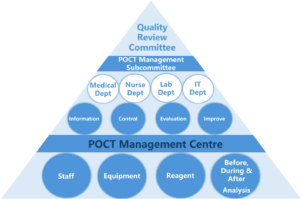
Under the central unit, a POCT subcommittee with specialised working groups is essential. These groups focus on specific testing areas, such as glucose monitoring and blood gas analysis, to name a few. While the upfront establishment of these specialised groups can be challenging, consistency leads to streamlined management in the long run.
We’ve built a cross-departmental, layered framework for POCT quality management. This structure ensures clear accountability and oversight at every step, from execution to management and decision-making.
Our POCT management centre is at the core of our operations:
-
-
- Personnel: We have a complete training and competency assessment system. This ensures everyone performing POCT has the right knowledge and operating skills.
- Equipment: We follow standard processes and keep detailed records from selection and installation to maintenance. We also have regular upkeep and repair procedures in place.
- Reagents: We strictly control everything from lot numbers and expiration dates to inventory.
- Analytical Process: We monitor the entire testing process, covering pre-analytical, analytical, and post-analytical phases.
-
Our management then extends to four key areas:
-
-
- Information: We ensure seamless connectivity between devices and test results.
- Control: We manage access permissions and review results for accuracy, boosting data reliability.
- Evaluation: We conduct internal audits and analyse quality indicators to regularly assess our processes and performance.
- Improvement: We hold regular review meetings and implement continuous improvement initiatives to ensure quality is upheld.
-
The POCT management centre acts as the core for horizontal integration, bringing together information, operational workflows, and quality audits. On top of this system, we’ve established a POCT Management Subcommittee to handle higher-level strategy and supervision. All POCT activities should have an oversight committee ensuring alignment with hospital policies and objectives. With this multi-level structure, a diverse network can be maintained at multiple levels.
Defining roles and responsibilities for effective POCT governance
Roles and responsibilities within this structure must be clearly defined, and this is where service agreements become crucial. These agreements outline the obligations of the POCT management centre, the operational units, and the support teams. Service agreements should include a detailed list of equipment with serial numbers, responsibilities for maintenance and calibration, data management protocols, and procedures for addressing errors or discrepancies in test results.
For example, a real-world scenario highlighted the importance of service agreements. A hospital that recently transitioned from consumer-grade glucose meters to internet-linked devices faced challenges during an ISO 15189 audit. They lacked a dedicated POCT management department and clear responsibilities defined in a service agreement. Post-audit, they rapidly developed and implemented a service agreement almost immediately to cover this gap.
Comprehensive training ensures operator competency
The human element is fundamental to successful POCT management, making staff training and competency assessment a top priority. New operators undergo instructor-led training sessions, augmented by e-learning. Yearly education programs are also assigned, and these sessions cover frequently encountered instrument errors and troubleshooting techniques, connectivity issues, digital maintenance logs, and proper data entry. They also cover new procedures or regulations that may have been introduced during the year. This way, all operators are kept up to date with the latest regarding the POCT devices they work on, as well as having clear electronic records for training and upkeep.
Management strategies for ongoing instrument and consumable checks
Ongoing maintenance and quality control are integral parts of the management strategy. Each instrument has a unique serial number, logged in the service agreement. To ensure ongoing competency, operator access rights will be reviewed and may be suspended if the instrument has not been used within the last six months, necessitating re-training. The IT system that links instruments to the laboratory information system and the hospital network is critical. It requires regular maintenance and serves as a real-time monitoring tool for instrument connectivity and QC results. Quality control data is closely monitored for trends, allowing for proactive interventions.
Consumable management is also crucial. Proper storage conditions for reagents, such as glucose test strips, are monitored and documented, with regular temperature checks to ensure compliance. Lot numbers and expiration dates are meticulously tracked, and inventory management ensures a consistent supply. When transitioning to new reagent lots, quality control testing is performed to validate their accuracy before clinical use. Reagent usage is also monitored and managed in coordination with user departments to prevent waste and ensure optimal inventory levels.
Leveraging technology for enhanced POCT management
An IT system is the cornerstone of effective POCT management. It facilitates instrument management, operator access control, result validation, and reporting. If the IT system fails, POCT operations can be significantly hampered. Real-time monitoring allows for immediate notification of disconnected instruments, enabling prompt troubleshooting.
Within the IT system, data visualisation tools play a critical role. When used effectively, they can significantly enhance clinical decision-making. For example, displaying patient wait times for POCT services, visualising test volumes across different departments and identifying peak periods, as well as charting instrument connectivity status, can provide valuable insights into workflow efficiency and potential bottlenecks. These insights can be leveraged for further optimisation of the operation, benefiting all stakeholders from an operational to management standpoint.
Quality control (QC) data is also integrated into the IT system. Any deviations from acceptable QC ranges trigger alerts, allowing for timely interventions, such as replacing potentially faulty reagents or recalibrating instruments. Consistently high readings in Level 1 QC samples may indicate improper storage or cross-contamination, prompting corrective actions.
Proactive risk management and continuous improvement
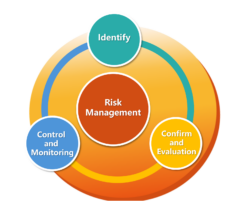
Risk management is a critical component, involving identifying potential risks, assessing their impact and likelihood, and implementing control measures. Common risks, such as incorrect patient identification numbers, are addressed through systematic processes and data analysis. A risk management table is used to document potential failures, their causes, criticality, and mitigation strategies. This proactive approach minimises errors and ensures patient safety.
Regular quality management meetings are conducted quarterly, involving key stakeholders such as nursing leaders, supervisors, and POCT staff. These meetings facilitate open discussions about challenges, improvement initiatives, and policy updates. Face-to-face discussions are valuable for resolving issues and fostering collaboration. Action items are documented, and progress is tracked to ensure timely resolution. The meetings also serve as a platform for building trust and enhancing communication among all parties involved.
Working towards AI integration for future POCT management
The future of POCT management includes the integration of artificial intelligence (AI) to further enhance accuracy and efficiency. AI can assist in data analysis, predictive maintenance, and real-time monitoring. By analysing vast amounts of data, AI algorithms can identify trends and anomalies, allowing for proactive interventions. AI can also predict potential instrument failures or reagent degradation, reducing downtime and ensuring continuous operation.
A strong commitment to patient safety
Effective POCT management requires a well-defined organisational structure with clear roles, responsibilities, and a strong emphasis on continuous staff training. These elements, alongside robust IT systems, comprehensive quality control measures, and a proactive approach to risk management, ensure the reliability of POCT results and ultimately contribute to improved patient safety and healthcare quality. As technology advances with AI-assisted POCT management, these foundational principles remain essential for effective and dependable healthcare delivery. Building trust, fostering collaboration, and maintaining a steadfast commitment to continuous improvement are key to achieving excellence in POCT management.
References:
[1] International Diabetes Foundation. (2025). IDF Diabetes Atlas 11th Edition. Available at: https://diabetesatlas.org/media/uploads/sites/3/2025/04/IDF_Atlas_11th_Edition_2025.pdf (Accessed 14 July 2025).


