



Key takeaways for benefits of lab automation:
-
-
-
- Small laboratories are vital to patient care and public health, particularly within decentralised healthcare systems.
- Modular automation offers tailored, flexible solutions for the unique challenges faced by small laboratories.
- Long-term ROI includes optimised staffing, improved accuracy, scalability, and expanded capabilities.
- Digital integration helps future-proof small laboratories for compliance, collaboration, and integrated care networks.
- Strong partnerships with laboratory automation providers ensure bespoke solutions and sustained development.
-
-
Whilst large-scale laboratories have traditionally pioneered automation, small laboratories have always been central to patient care – particularly within decentralised healthcare models. Today, these essential laboratories deserve solutions tailored to their specific needs, not as a means of catching up, but in recognition of their critical frontline role. With the trend in healthcare moving towards decentralisation and care in the community, the attention must now shift to a segment that has previously been under-appreciated yet is crucial in nature: the small laboratory. [1]
Typically embedded within community hospitals, diagnostic centres, or regional clinics, small laboratories can process up to 250 samples per day. [2] Despite their size, small laboratories play a critical role in ensuring timely diagnoses, shaping treatment outcomes, and strengthening public health infrastructure. As the pressure on these labs increases, especially in developing markets such as India, China, and Vietnam, the argument for bringing in automation is stronger than ever. [3]
The overlooked segment: why small laboratories matter
Despite their size, small laboratories are integral to the healthcare system, especially in rural and semi-urban areas where they often serve as the first point for patients requiring diagnostic services – such as complete blood counts, liver and renal function tests, infectious disease screenings, and metabolic panels. These are not trivial tasks; they are essential for timely diagnosis, treatment monitoring, and disease prevention. [1]
Any disruption to laboratory operations directly impacts patient care with resulting consequences such as postponed treatments, prolonged hospital stays, and increased healthcare costs. By streamlining workflows and reducing errors, small labs can enhance their service quality, leading to better patient outcomes. [1]
Naturally, small labs have their own set of challenges that differ from larger laboratories, often requiring greater agility, multitasking staff, and rapid turnaround with limited resources. Automation is uniquely positioned to meet these needs.
Without laboratory automation, these pressures often manifest as staff fatigue, high error rates, and inefficient workflows. In this context, automation is not a bonus – it is an operational imperative.
Debunking the cost myth
One of the most persistent misconceptions is that automation is prohibitively expensive for smaller laboratories. Historically, early automation systems were designed for high-volume central labs and came with considerable costs in terms of space, infrastructure, and integration. [3] However, today’s market has evolved.
Modern automation platforms are built to be modular, scalable, and flexible. This means labs can start small – automating a single process such as sample sorting or centrifugation – and scale up as needs grow. Instead of replacing existing infrastructure, these systems augment workflows in a phased and affordable manner. [4]
Consider a small laboratory in Vietnam handling approximately 250 samples daily. Initially, this lab relies on three technicians per shift, with a 5% sample error rate due to manual pipetting and labelling. With modular automation, the lab implements an automated sample preparation system, reducing error rates by 80% and enabling it to reassign one technician to value-added tasks like data analysis and quality assurance. Within two years, the lab recoups its investment while improving its reputation, service capacity, and readiness for accreditation.
Modular automation is a smart fit for small laboratories
At its core, modular automation refers to a system design that allows laboratories to introduce automation in phases, starting with a single task (e.g., sample sorting or centrifugation) and scaling up over time. [5] This approach differs from Total Laboratory Automation (TLA), which requires a comprehensive overhaul of processes and higher capital expenditure from the outset. [6]
Modular solutions offer several advantages for small labs:
-
-
-
- Custom Start Points: Labs can begin with their biggest bottlenecks – whether it’s pre-analytical steps like sample sorting, or post-analytical ones like archiving.
- Scalability: New modules can be added over time to extend the lab’s capabilities.
- Digital Integration: Dashboards, cloud analytics, and automated alerts are often embedded, enabling labs to make data-driven decisions.
- Reduced Downtime: Some systems offer predictive maintenance features, minimising disruptions.
-
-
In other words, modular automation isn’t about going “all in” from day one. It’s about evolving with your lab’s growth curve – at your pace, on your terms.
Whether a lab processes 400 or 4,000 samples a day, the expectation is the same: deliver results that are accurate, timely, and compliant with national and international standards. This is where automation becomes a game-changer for smaller labs. [1]
Smaller labs often have fewer personnel, meaning fewer quality checkpoints and more reliance on individual performance. Automation standardises critical steps, reducing reliance on manual input and ensuring a consistently high quality of output. [7]
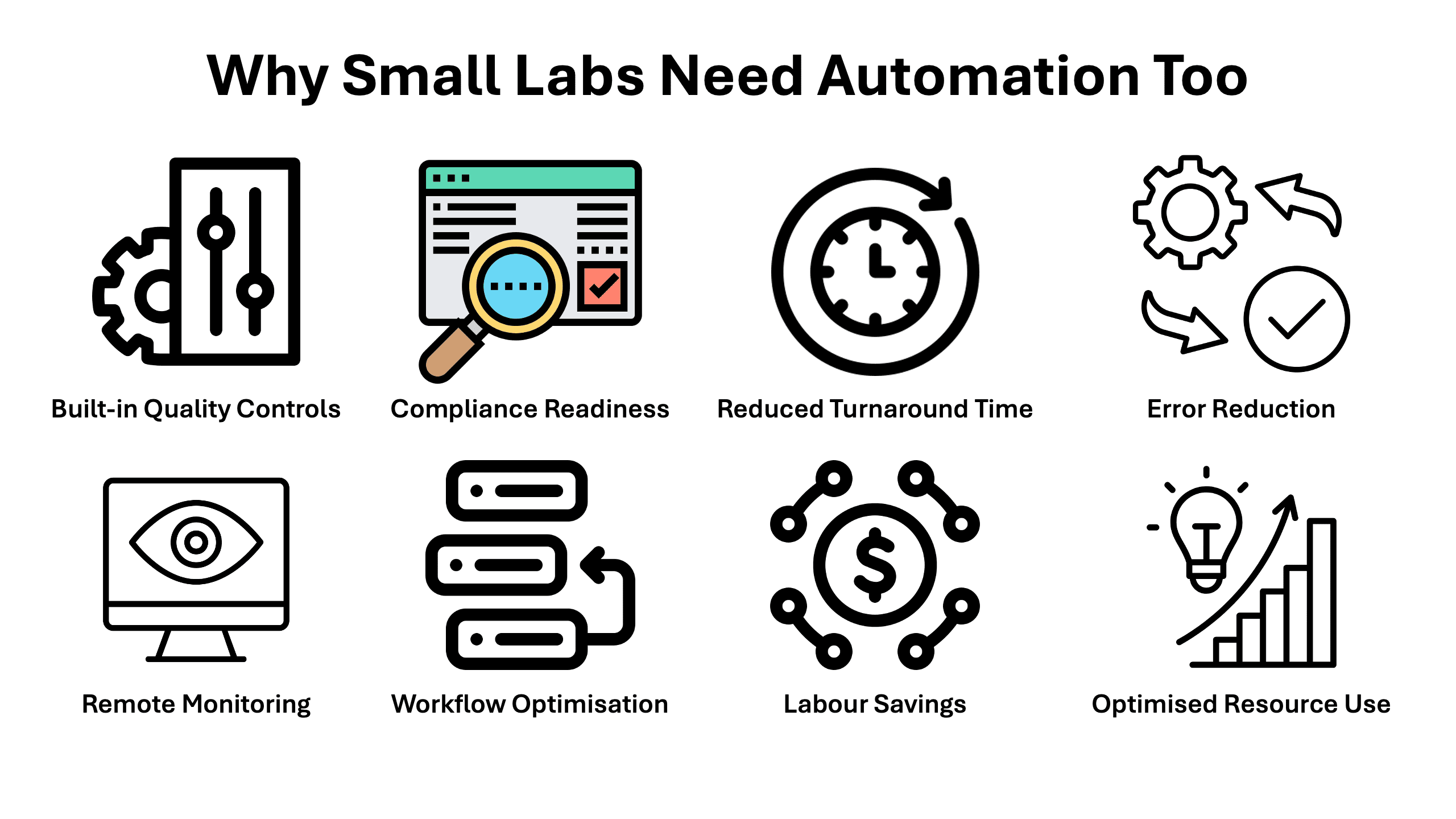
How automation help small labs maintain standards:
-
-
-
- Built-in Quality Controls: Platforms include features like auto-calibration, error detection, and repeat flagging. These increase precision and reduce manual handling in processing, yielding consistent and reliable results.
- Remote Monitoring: Lab managers can monitor system performance and workflows in real time – even from remote locations.
- Compliance Readiness: Digital logs, auto-generated reports, and audit trails streamline accreditation processes and regulatory inspections.
- Workflow Optimisation: Systems learn from usage patterns and can suggest workload distribution improvements, reducing bottlenecks.
- Labour Savings: Automation reduces the need for night shifts, redundant manual handling, and sample reruns caused by errors.
- Reduced Turnaround Time: Faster processing leads to more timely diagnoses and better clinical decision-making.
- Error Reduction: Automated systems standardise procedures, eliminating the variability introduced by manual steps. Automation has been shown to reduce human error and increase productivity.
- Optimised Resource Use: Systems can be programmed to dispense reagents with high precision, cutting waste and improving cost-efficiency.
-
-
More importantly, automation gives small labs the opportunity to participate in regional health networks, telehealth ecosystems, and disease surveillance initiatives. With centralised data, synchronised workflows, and digital reporting tools, small labs can operate at a standard consistent with national reference centres – without needing to increase their headcount drastically. [8, 9]
This capacity to meet the same standards as high-volume labs is what ultimately positions small laboratories as vital contributors to public health initiatives, including outbreak tracking, health screenings, and chronic disease monitoring. [1]
In India, many diagnostic centres in Tier 2 and Tier 3 cities are leveraging modular automation to meet growing demands without the need to physically expand. For these labs, automation is not about catching up to big-city labs – it’s about sustaining long-term growth and delivering consistent results, even in resource-limited settings. [10]
Building long-term partnerships
Successful implementation of automation in small labs is not just about providing a box of hardware. It’s about fostering a long-term relationship based on understanding, collaboration, and support. Vendors and service providers must act as strategic partners, offering consultation, training, and post-installation support that evolves with the lab’s changing needs. This includes:
-
-
-
- Assessing workflow needs: Understanding the lab’s specific requirements before implementation.
- Training staff: Ensuring that laboratory personnel are proficient in using and troubleshooting the systems.
- Providing remote assistance: Offering ongoing support and system updates.
- Offering upgrade pathways: Facilitating system enhancements as the lab scales.
-
-
In this way, the lab is not locked into a single solution, but rather equipped with a living, evolving system designed to meet the needs of today – and tomorrow. [1]
Why automation is your lab’s next step
Automation must no longer be defined by scale. For small laboratories – often the unsung heroes of community healthcare – automation serves as a strategic enabler that amplifies their strengths, broadens their reach, and secures their future role within resilient healthcare systems.
Through scalable, modular solutions and integrated digital support, small laboratories can achieve the same level of performance, reliability, and growth-readiness as the largest reference labs. More than just a technological upgrade, automation is an investment in future-proofing your operations, enhancing clinical outcomes, and positioning your lab as a modern, trusted player in the healthcare continuum.
Whether you’re managing a 500-sample-a-day lab or overseeing diagnostics in a semi-urban centre, the message is clear: Automation is for you, too.
References:
[1] ul Islam, Shahid, Kanika Kamboj, and Ankita Kumari. 2023. “Laboratory Automation and its Effects on Workflow Efficiency in Medical Laboratories.” Middle East Journal of Applied Science & Technology (MEJAST) 6 (4): 88-97. Accessed 2025. doi:https://doi.org/10.46431/MEJAST.2023.6407.
[2] Badrick, Tony , Jozica Habijanic, Sam Yew Mah, and Elizabeth Arcellana-Nuqui. 2019. “Philippines Diagnostic Pathology Laboratory Benchmarking.” Philippine Journal of Pathology 4 (2): 15–23. Accessed 2025. doi:https://doi.org/10.21141/PJP.2019.11.
[3] Rupp, Nicole , Katrin Peschke , Michael Köppl , David Drissner , and Thole Zuchner . 2022. “Establishment of low-cost laboratory automation processes using AutoIt and 4-axis robots.” SLAS Technology 27 (5): 312-318. Accessed 2025. doi:https://doi.org/10.1016/j.slast.2022.07.001.
[4] Züchner, Thole, and Nicole Rupp. n.d. “Laboratory Automation: Unsolved Problem of Small and Medium-sized Enterprises.” Accessed 2025. https://opus.bsz-bw.de/hsas/frontdoor/deliver/index/docId/106/file/Zuechner_Rupp_Unsolved_problem.pdf.
[5] Felder, Robin A. 1998. “Modular workcells: modern methods for laboratory automation.” Clinica Chimica Acta 278 (2): 257-267. Accessed 2025. doi:https://doi.org/10.1016/S0009-8981(98)00151-X.
[6] Al Naam, Yaser A, Salah Elsafi , Majed H Al Jahdali , Randa S Al Shaman, Bader H Al-Qurouni, and Eidan M Al Zahrani. 2022. “The Impact of Total Automaton on the Clinical Laboratory Workforce: A Case Study.” Journal of Healthcare Leadership 14: 55-62. doi:https://doi.org/10.2147/JHL.S362614.
[7] 1997. “Automation and Consolidation: The Future of Laboratory Medicine.” SLAS TECHNOLOGY: Translating Life Sciences Innovation 2 (1): 11-15. doi: https://doi.org/10.1177/221106829700200103
[8] Javaid , Mohd , Abid Haleem , and Ravi Pratap Singh . 2024. “Health informatics to enhance the healthcare industry’s culture: An extensive analysis of its features, contributions, applications and limitations.” 1 (2): 123-148. Accessed 2025. doi:https://doi.org/10.1016/j.infoh.2024.05.001.
[9] Amjad , Ayesha , Piotr Kordel , and Gabriela Fernandes . 2023. “A Review on Innovation in Healthcare Sector (Telehealth) through Artificial Intelligence.” Sustainability 15 (8): 6655. Accessed 2025. doi:https://doi.org/10.3390/su15086655.
[10] Sharma, Kalyani . n.d. “Express Healthcare.” Transforming healthcare in tier 2 & tier 3 cities with health IT. Accessed 2025. https://www.expresshealthcare.in/news/transforming-healthcare-in-tier-2-tier-3-cities-with-health-it/447241/.


