



For clinical laboratory teams, the most frustrating errors might be the ones they can’t control — because they occur outside the lab. Indeed, most errors can be traced back to sources in the pre-analytic phase. According to an independent study, 62% of errors occur in this stage; 15% of errors happen during analysis, and 23% of errors are made in the post-analytical phase [1]. A key contributing factor is the continued reliance on manual processes used in pre-analytic techniques.
With better upstream management and automation tools, clinical laboratory teams can help phlebotomists and other members of the pre-analytic phase reduce the number of errors that take place. The first step is to identify the source of problems. For example, during venous blood sampling, many phlebotomists fail to correctly identify patients, leading to the dreaded “wrong blood in tube” error. In the worst cases, patient misidentification or using the wrong tubes can lead to serious errors and significant inefficiency. These mistakes — such as when a phlebotomist accidentally uses incorrect tube type for the tests ordered — mean the patient often has to return to get their blood drawn again. This not only wastes the patient’s time but also creates delays in care.
To take another example, improper specimen collection and handling is the largest category of pre-analytic errors. This is often caused by human error or distraction, according to a survey of U.S. hospital staff.
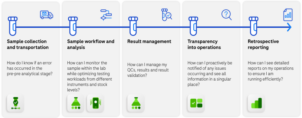
To reduce errors in the pre-analytic phase, it’s worth considering the full spectrum of areas where improvement may be an option:
-
- Order management: Digital options can be useful for managing orders across several systems and for providing key information to other parties in the process
- Sample collection: Establish standard protocols for tube filling, patient identification, container selection, order interpretation, and more
- Transportation: This is where tubes can go missing or be stored without proper refrigeration; careful tracking can help labs manage the workload and track samples during shipment, as well as perform direct-to-analyser loading
- Sample reception: These tasks are often performed manually, but receiving and processing samples can be made more efficient and error-free with automation
Most of the potential problems attributable to these areas have fairly simple fixes. Consider the challenge of something as basic as misaligned labels on a specimen. Overlooking small, near-negligible errors like this can cause a ripple effect and disrupt efficient workflow and productivity. Misaligned labels interfere with proper barcode reading and can result in samples being rejected at the clinical lab.To go back to an earlier example: the Clinical and Laboratory Standards Institute has developed standards to help ensure correct identification of patient samples, with requirements for information that should be included on electronically generated labels [2].
Since pre-analytic errors are often associated with manual tasks, implementing automated solutions can be an effective way to reduce errors, improve efficiency, standardise processes, and decrease overall hospital costs. There are automated devices to support a wide range of steps in the pre-analytic phase, such as: sample tube preparation and correct labeling; sample transport to the laboratory; automated sample sorting at the laboratory to reduce sample reception bottlenecks; standardised check-in for proper patient identification and queueing; and location tracking for samples and time-stamping each step in the pre-analytic workflow with a connection to the LIS for transparency throughout the process. Implementing automated solutions also provides a workflow that is more conducive to lab technicians that enables a steady state-of-mind without the need for constant interruptions that manual tasks demand.
More recently, evolution in the automation field has led to the availability of integrated solutions that manage everything from patient check-in, to laboratory sample reception. This holistic approach aims to reduce the potential for errors by minimising manual steps. Typically, an integrated system will read patient ID cards and create patient-specific tube kits for sample collection, create a queueing system, perform pre-phlebotomy labelling and transportation, move samples to the laboratory, and load and sort samples upon arrival at the lab. These automation setups are most commonly used at large phlebotomy centres, hospital wards, and even decentralised sample collection centres such as physician practices.
Interestingly, Asia is a hotbed of innovation in the pre-analytic sample automation space. Many companies offering integrated solutions are based in China, Japan, and South Korea. Technologies are often designed to complement the automated solutions already used in clinical laboratories for optimal utility.
With collaborative efforts among clinical laboratories, automation providers, and other hospital stakeholders– it is now possible to greatly reduce the pre-analytical error rate through the implementation of automated technologies.
References:
[1] Carraro, P. and Plebani, M. (2007) ‘Errors in a Stat Laboratory: Types and Frequencies 10 Years Later’, Clinical Chemistry, 53(7), pp. 1338–1342. Available at: https://doi.org/10.1373/clinchem.2007.088344
[2] Clinical and Laboratory Standards Institute (2018) Prevention of Specimen Labeling Errors in the Lab. Available at: https://clsi.org/resources/insights/prevention-of-specimen-labeling-errors-in-the-lab/ (Accessed: 3 September 2025).


