


In healthcare, the margin between life and death is measured by timely and precise clinical intervention. With diagnostics influencing the vast majority of clinical decisions [1], the laboratory serves as the definitive point of clarity – where clinical certainty calls, the lab answers.
To meet surging testing demands, labs are pivoting to total lab automation (TLA) to help ease and strengthen workflow processes. But such a transition is rarely a simple tech upgrade; it is a profound organisational shift that requires the unlearning of legacy protocols and relearning of new technological workflows and language. Change is uncomfortable for anyone, and can be met with resistance when not done patiently.
Spearheading a transformation of this magnitude requires more than just technical acumen – it demands a patient, people-centric leadership. These are hallmarks of the strategy employed by Laboratory Associate Director Ms Anastacia Pajarillaga during Raffles Diagnostica’s recent TLA transition.
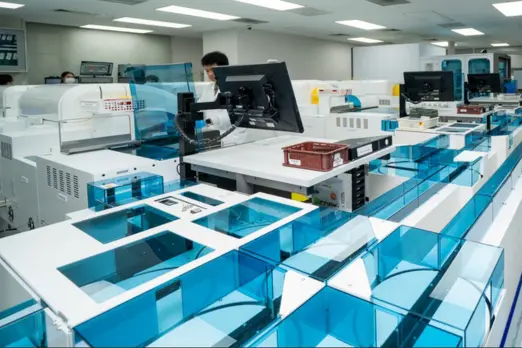
As the clinical laboratory arm of Raffles Medical Group, Raffles Diagnostica operates as a critical hub, serving over 50 outpatient clinics across Singapore from its central location at Raffles Hospital at North Bridge Road. With a daily influx of over a thousand samples, traditional reliance on manual intervention was bound to reach its limits. “There [used to be] a lot of manual intervention in the past, so based on that experience, I thought it would be beneficial for [Raffles Diagnostica] to have TLA.”
Yet, while TLA seemed like a beacon of hope for managing high-throughput demands, Ms Ana understood a fundamental truth of change management: the greatest barrier to innovation is not machinery, but the natural human apprehension that accompanies a total disruption of the status quo – all while navigating the operational rigour required to sustain a 24/7 service without interruption.
Changing the wheels while in motion: sustaining uninterrupted 24/7 critical services
“[TLA] for us was like changing the wheels of the car while it is still running,” says Ms Ana, referring to how sustaining a 24/7 operation comes with its own set of challenges, often requiring precise planning to ensure usual operations are not disrupted despite the change. Maintaining business-as-usual is key, shared Ms Ana, “I cannot afford to have downtime because we are serving critical services like ICU, OT, and Raffles Acute and Critical Care Departments”.
Clear communication across working teams and ample support made all the difference. “My team was very supportive,” Ms Ana recalled. Proper working schedules between teams and construction vendors were planned. Major construction was primarily done on the weekends or midnight-to-early mornings, as these timings had lesser workload. To capitalise on this efficiency, Raffles Diagnostica’s lab information system (LIS) was also changed concurrently during the initial planning stages.
Moreover, it was active sponsorship that made all the difference – Ms Ana displayed active and visible leadership, she built a coalition with IT and vendors to alleviate issues during the period of disruption during the 24/7 transition, and communicated directly with her staff.
The pulse of the lab is the heart of change
At the heart of the overhaul wasn’t just new technology, but a people-powered strategy that turned a daunting shift into a self-directed journey. “I have staff that are working [at Raffles Diagnostica] for 10-20 years, it is normal for them to be used to their usual ways of working,” Ms Ana recalls past concerns, “some might not be so keen to change.”
However, the secret to a seamless TLA transition lies in Ms Ana’s “inside-out” philosophy: treating employees not as subjects of change, but as its primary architects. Roping in her team from day one provided them with a sense of ownership, allowing them to co- design and co- create not just their future physical workspace, but also to understand the mechanism behind the modernised systems they would be eventually operating. Ms Ana noted that once her team understood the broader benefits of TLA, they became “more eager and supportive of the change.”
Ms Ana’s “change from within” philosophy creates a real-world mirror of the Prosci ADKAR model – a framework essential for navigating the human side of organisational shifts. She began by building Awareness of the lab’s operational reality: with over a thousand daily samples, the reliance on manual intervention had reached its limits. She then fostered Desire by focusing on the ‘WIIFM’ (What’s In It For Me), positioning TLA not as a replacement, but as a liberator that would free staff from repetitive burdens like manual centrifugation. Crucially, Ms Ana avoided the common pitfall of rushing into technical training (Knowledge) before the team was emotionally onboard. Instead, she treated her staff as the ‘primary architects’ of the transition. By involving them in the co-design of their future workspace, she transformed abstract instructions into practical Ability, allowing the team to navigate the complexity of ‘changing the wheels while the car was still running’. Today, the team’s enduring cohesion serves as powerful Reinforcement, proving that when leadership fosters psychological safety, the workforce shifts from a state of defense to receptive engagement.
This collaborative, hand-held approach also sparked a lot of excitement during TLA implementation. “[Employees] were keen to see the process,” Ms Ana reflects, noting how there was a genuine interest to experience firsthand how the new workflow would reshape their daily practices. She also noticed the early involvement fostered team cohesion, “until now, my team is strong because they were involved from the beginning, they saw through the lab from partial to full automation.” This isn’t just mere inclusion, but rather encouraging process ownership. Ms Ana’s staff were not just picking furniture; they were defining the logic of the automation process, which is core of the workflow planning event/resource planning event value proposition.
While big changes naturally trigger a considerable amount of fear and anxiety, Ms Ana credits the success to the unwavering cooperation from her team. In retrospect, she reflects that anxiety often stems from the opacity and sudden speed of change, and being blind to the process only makes the transition more intimidating than it actually is. Psychological safety seemed to be a condition for progress. When the fear of the unknown is mitigated by a supportive culture, the workforce is more likely to shift from a reaction of defense, to one of receptive engagement. “Usually, employees only see the final result, that feeling is very foreign and that’s what scares them. But if you [invite them in] from the start and show them the entire journey, they are more receptive to change,” Ms Ana affirms.
For Raffles Diagnostica, success was found in the human element; it was the agency granted to the team that made the TLA realisation a truly rewarding experience. Change management doesn’t always have to be scary, oftentimes, inclusion, transparency, and involvement of lab staff help alleviate the fear of new technology, allowing a smoother transition.
TLA empowers lab professionals, not replace them
Clinical laboratory professionals are the quiet, unsung heroes of the healthcare systems providing diagnostic clarity that support life-saving treatments[1, 2]. Yet, this vital workforce faces a mounting global shortage [3, 4]. Ms Ana recognises that the true value of TLA lies in its assistive ability – to liberate the workforce, allowing them to transcend routine tasks and empower them to move on to more specialised, high-impact roles.
“I think [the lab professional manpower shortage] is a global issue,” Ms Ana reflects, acknowledging the rigorous nature of the diagnostic industry that often goes unseen by the public. In Raffles Diagnostica, TLA was never about replacing the human element, it was about liberating it. By automating the repetitive and mechanical burdens of the bench – such as manual centrifugation and sample sorting – the lab can finally capitalise on its most precious asset: the intellectual expertise of its people. “[My staff] can now focus on other areas that improve quality of work, for example, high-value tests, instead of things like centrifugation”, Ms Ana recalls. This creates a culture of continuous professional development; TLA as the partner that handles the mundane, allowing staff to reclaim their roles as scientific experts and critical thinkers, ensuring that their work remains as fulfilling as it is essential.
This transition from mechanical execution to intellectual oversight is timely. It transforms the lab into a proactive tool for wellness, capable of meeting the mounting diagnostic demands of a changing society.
The value of lab diagnostics: present and beyond
In Singapore, the pressure to help its people age well has become “a looming crisis,” as quoted by local newspaper The Straits Time [5]. In addition, one in four people in Asia and the Pacific will be over 60 years old, with the population of people over this age group projected to reach close to 1.3 billion [6]. With clinical diagnostics influencing up to 70% of clinical decisions [1], the convergence of an aging population and escalating healthcare needs has created a high-stakes environment for laboratory medicine.
Translating these demographic pressures into a mission, Ms Ana maintains that the laboratory is the diagnostic bedrock of healthy aging, providing baseline intelligence required for preventive care, essentially turning clinical data into a roadmap for sustained longevity. “Nowadays, patients are also keen to know if they are susceptible to certain disease types, not [necessarily] because they have some underlying conditions,” Ms Ana explains, alluding to how the lab can play a key role in longevity screening and disease monitoring.
A human-centric future
Ultimately, the success of Raffles Diagnostica’s full automation transition proves that the most sophisticated piece of equipment in any lab is still the human mind. By anchoring TLA in an ADKAR-guided philosophy of inclusion and empowerment, Ms Ana has done more than just modernise a workflow; she has future-proofed a team. As Raffles Diagnostica moves to accommodate diagnostic demands of preventive care and longevity screening, the lab is no longer just a site of mechanical testing, but a hub of clinical intelligence.
In the high-stakes journey of healthcare, technology may provide the speed, but it is the empowered, expert workforce — integrated from the very first blueprint — that provides the direction. This success story demonstrates that a seamless TLA transition is not merely the result of good leadership, but also of a structured, replicable methodology – an ADKAR-aligned blueprint that any laboratory can take inspiration from to navigate the complexities of large-scale digital transformation. For Raffles Diagnostica, this ‘inside-out’ approach has ensured that when the future of medicine calls, a prepared and passionate team is ready to answer.
References
[1] Sikaris, K.A. (2017) ‘Enhancing the clinical value of medical laboratory testing.,’ PubMed, 38(3), pp. 107–114. https://pubmed.ncbi.nlm.nih.gov/29332975.
[2] Scott, K. (2016) ‘Will teamwork fix the diagnostic error problem? National Academy of Medicine report calls for change,’ Association for Diagnostics & Laboratory Medicine, 1 January. https://myadlm.org/cln/articles/2016/january/will-teamwork-fix-the-diagnostic-error-problem-national-academy-of-medicine-report-calls-for-change (Accessed: March 3, 2026).
[3] The American Society for Clinical Laboratory Science (2021) Addressing the clinical laboratory workforce shortage. https://ascls.org/addressing-the-clinical-laboratory-workforce-shortage/ (Accessed: March 3, 2026).
[4] Nicholls, M. (2025) ‘Staff shortage in the medical lab: solutions for a growing challenge,’ Healthcare in Europe, 25 August. https://healthcare-in-europe.com/en/news/staff-shortage-medical-laboratory.html.
[5] Fung, D. (2025) ‘Super-aged, superlative: Ageing with meaning and dignity in Singapore,’ The Straits Times, 14 December. https://www.straitstimes.com/singapore/health/super-aged-superlative-ageing-with-meaning-and-dignity-in-singapore.
[6] Fang, C.S. (2022) ‘S’pore’s population ageing rapidly: Nearly 1 in 5 citizens is 65 years and older,’ The Straits Times, 28 September. https://www.straitstimes.com/singapore/singapores-population-ageing-rapidly-184-of-citizens-are-65-years-and-older.


