



Mass spectrometry has long been heralded as a powerful analytical tool in the realm of testing, offering an unparalleled ability for accuracy and precision. Historically, mass spectrometry has been considered a form of niche testing. Typically located in specialised, tertiary or research institutions, access to the benefits mass spectrometry testing has to offer has been somewhat limited.
In recent years, there has been a greater push towards transitioning this niche form of testing into broader adoption in clinical laboratories. While full of promise, this process requires specialised expertise and resources. To learn more about how one lab is addressing this challenge, the Lab Insights team spoke with Dr Terumichi Nakagawa, Clinical Chemistry Lead at the Clinical Laboratory at Keio University Hospital.
Mass spectrometry testing capabilities at Keio University Hospital
Keio University Hospital’s Department of Clinical Laboratory Science is considered a tertiary laboratory with a daily sample load of 1,500 to 1,700 per day in an institution that has been serving the greater Tokyo metropolitan area for decades. The laboratory takes care of testing for several departments within the hospital with a wide testing menu.
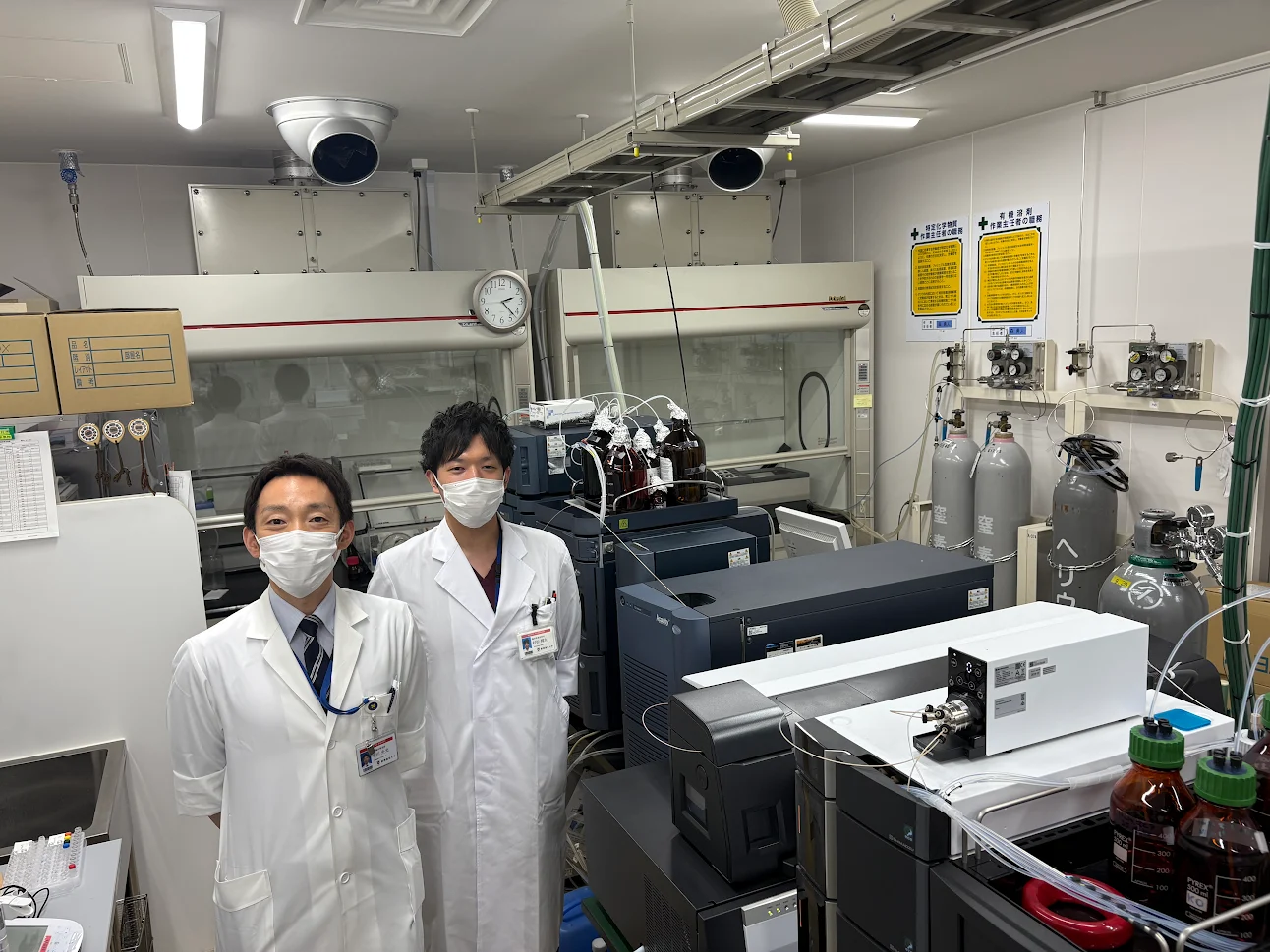 Pictured: Dr Nakagawa (L) and colleague in the mass spectrometry room at Keio University Hospital
Mass spectrometry testing capabilities were first introduced into Keio University Hospital’s lab in 2013, and now leading the charge is Dr Nakagawa. He recalls how his fascination with mass spectrometry began with a lecture at Kyorin University. The discussion of its application in drug and toxicology testing showcased the enormous potential of the technology. “I was impressed by the ability of mass spectrometry to look specifically at molecules to see a wide variety of substances,” he explained. This initial encounter led him into deeper exploration and broader application of the technology in a clinical setting.
Stakeholder recognition of the value of mass spectrometry testing
In his institution, mass spectrometry has been leveraged to measure urinary steroid metabolites – a capability that reflects the precision and specificity of the technology. This testing method was established by Keio University Hospital’s very own Dr Keiko Honma, turning the hospital’s mass spectrometry capabilities into a national resource, with samples arriving from across Japan. However, due to financial constraints, this valuable diagnostic method has been suspended.
Despite this funding issue, the growing interest among physicians continues to drive conversations about the technology. “Doctors [..] have made many enquiries about mass spectrometry measurements,” noted Dr Nakagawa. Physicians are keen not only to understand how to better interpret results, but also to explore mass spectrometry’s potential in research collaborations with clinical labs.
Globally, the growing number of research papers demonstrating mass spectrometry’s value in clinical decision-making has amplified interest. “The increasing availability of mass spectrometry instruments,” Dr Nakagawa observed, “is also helping to lower the hurdles for their use in medical environments.” Soon, Dr Nakagawa expects that mass spectrometry will change how physicians approach evidence collection for their clinical practice.
Barriers to wider mass spectrometry adoption
While the potential of mass spectrometry in clinical laboratories and practice is clear, its adoption faces several notable challenges. According to Dr Nakagawa, the most significant barriers include financial costs, environmental requirements and in Japan, its insurance system.
One of the foremost challenges is cost. Mass spectrometry equipment represents a significant investment due to its cutting-edge technology. This high upfront cost, combined with the inefficiency of processing large sample volumes, creates economic hurdles. “It takes a long time to recover the cost of the equipment, making it less appealing to laboratories with tight financial constraints,” Dr Nakagawa remarked.
Another challenge is the infrastructure required to accommodate the technology. Mass spectrometers rely on organic solvents, necessitating robust exhaust ventilation systems. Laboratories, particularly those in older facilities, may lack these capabilities, making implementation logistically complicated.
Moreover, the lack of compatibility with Japan’s insurance reimbursement system adds another layer of difficulty. The insurance point system, designed to allocate testing costs, fails to accommodate many of the advanced functions where mass spectrometry excels, making cost recovery even harder. While initial costs are high, institutions should take into account the significant value these instruments can provide in the long term. It is important to view this investment not only in a financial sense, but also as a strategic involvement to support the future of diagnostic testing and overall healthcare for communities.
Transforming mass spectrometry into an accessible diagnostic method
Recognising these challenges, Dr Nakagawa believes the key to broader adoption of mass spectrometry lies in demystifying the technology and making it more user-friendly. “Mass spectrometry needs to shed its image as something that is only for experts,” he emphasised. Currently, many diagnostic technologies thrive because they are easy to operate and integrate smoothly into clinical workflows. By simplifying the interface and operation of mass spectrometry instruments, it will become more approachable for non-specialists, similar to other new technologies on the market.
To convey the value of this diagnostic method to physicians, Dr Nakagawa sees it as being driven by three key factors: 1) its ability to rapidly adapt to a diversifying range of analytes, 2) its capacity to provide high-evidence-level test results through more specific measurements, and 3) its capability to handle disease markers that are becoming more minute and difficult to measure.
Mass spectrometry is thriving in Western medical applications, and Dr Nakagawa believes Japan is on a similar trajectory. The rising demand for higher precision and broader analytical range will make mass spectrometry an essential tool. “It is important to propose the use of mass spectrometry in appropriate situations and to recognise its unique value,” he advises. He envisions a future where healthcare professionals appreciate the distinctive capabilities of mass spectrometry and can confidently propose its use in appropriate clinical scenarios.
Pioneering a path forward with mass spectrometry
The journey to incorporating mass spectrometry into clinical laboratories may not be without its difficulties, but the rewards are undeniable. More than a tool for measurement, mass spectrometry is a gateway to higher precision, better evidence, and a transformative approach to medical diagnostics and better patient outcomes.
With this in mind, Keio University Hospital’s clinical laboratory is taking the steps towards this future, with plans to integrate their institution’s mass spectrometry testing into their routine clinical laboratory practices.


