


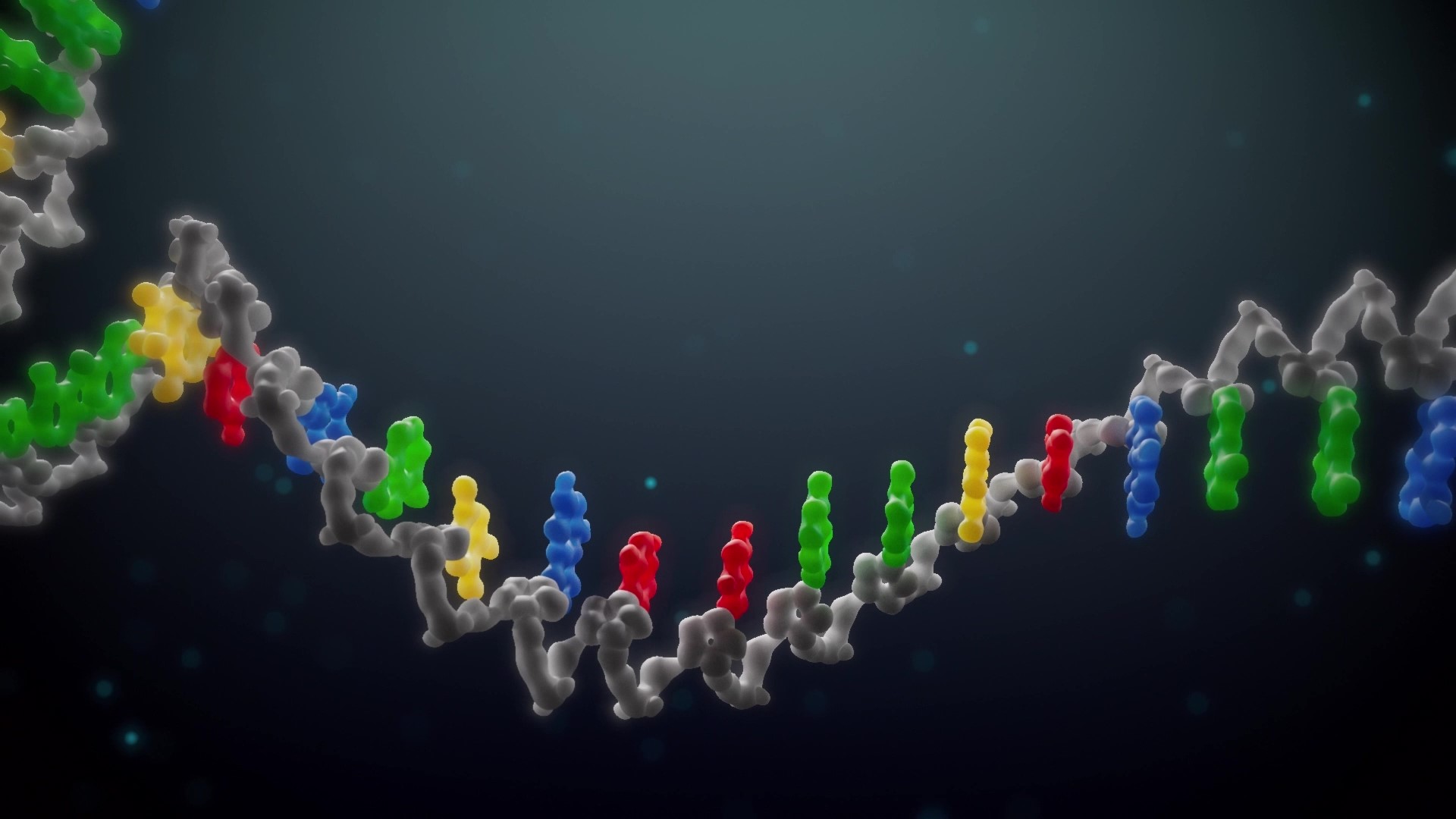
It is truly a golden age for DNA sequencing technologies. From the sequencing-by-synthesis tools that gained traction in a Sanger-dominated landscape to single-molecule and nanopore sequencing, there’s more opportunity than ever to find the right sequencer for each application.
Now, there’s a new type of sequencing technology on the horizon: sequencing by expansion (SBX). With read lengths running from 50 bp to more than 1,000 bases and rapid sequencing speeds that enable near real-time analysis, SBX could be a good fit for laboratories interested in somatic or germline whole genome sequencing or other applications.
The unique SBX approach incorporates advances in nanopore sequencing methods combined with novel chemistry that creates an expanded version of the original molecule for easier and more accurate analysis. While nanopore sequencing offers a number of advantages, developers have long struggled with the challenge of detecting the signal from each base, in order, without accidentally picking up signal from other bases in close proximity or missing bases because the molecule moved through the nanopore too quickly. The SBX approach overcomes that issue by detaching nucleic acids from their helical backbone and leveraging novel reporters, maintaining their correct sequence while increasing the distance between them to enable more accurate detection through a nanopore.
The SBX process begins with the creation of a complementary molecule followed by a biochemical reaction that expands the molecule into a polymer called an Xpandomer, which is then pulled through a nanopore reader to enable rapid sequencing of individual molecules. With millions of nanopores embedded into a high-density sensor array, sequencing can be done at scale — SBX technology can read hundreds of millions of bases per second.
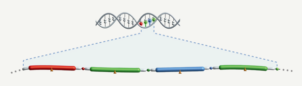
Building the Xpandomer
The Xpandomer is created from a conversion process that expands the original DNA template, encoding its sequence into a polymer with greater distances between each base. Xpandomers are built from expandable nucleotide triphosphates, or X-NTPs. There are four X-NTPs, one corresponding to each base, and they have been engineered to be easily differentiated from each other.
X-NTPs act as substrates during the replication process that converts the original template into an Xpandomer. Fueled by a polymerase called XP synthase, this process has been demonstrated to achieve excellent raw read accuracy and longer read lengths without being stymied by GC content. The final Xpandomer is more than 50 times longer than the initial DNA template.
Reading the Sequence
Once the DNA template has been converted into an Xpandomer, it’s ready to be fed through a biological nanopore, where the identity of each base can be detected. The polymer is guided through the pore using electrical pulses that move the molecule one base at a time.
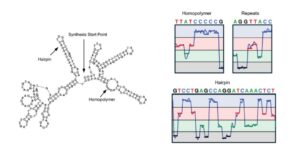
Figure 1 (left): Secondary structure of a 222-mer template being sequenced. This structure was generated via DNA secondary structure prediction tool on vectorbuilder.com
Figure 2 (right): Magnified regions of ion current traces demonstrating SBX sequencing of homopolymer, repeat, and hairpin regions. Taken from preprint (see below for more).
With millions of pores running at once, SBX technology should enable users to initiate base calling even as the polymer is being read and to stop the run after sequence requirements have been satisfied. Data processing can also begin during the run, allowing researchers to begin early analysis even as sequence data continues to be collected. Unlike most sequencers that have a fixed run time, the SBX run times are adjustable to support various needs, such as small batch multiplexing or optimising for longer reads.
SBX Advantages
The SBX technology was engineered with flexibility and performance in mind. It offers a number of advantages compared to other sequencing techniques today, and scientists are working to continue
improving its performance. Current benefits include:
-
-
-
- Flexible operation that is tunable to sample needs
- High accuracy with demonstrated F1 scores of >99.80% (SNV) and >99.7% (indel) for HG001 whole
genome samples - Very high throughput, with the ability to sequence seven genomes in 1 hour at >30x; >5B duplex
reads in 1 hour of sequencing - Flexible read lengths spanning 50bp to >1000bp
- Ultra-fast workflow options for urgent samples, including sample to variant call format in <7 hours
- Cost efficiency enabled by a scalable and reusable sensor module
-
-
At the time of writing, the SBX technology is still in development and will be for research use only. For more technical details about the SBX technology, as well as results from a pilot sequencing project, please refer to this preprint.


